Woodland and Heath
There is a long term Forestry Commission project to restock the Affpuddle and Moreton woods and heathland over the next 20 years. Some areas of conifers will be removed and a few areas will be replanted, some with conifer and some with broad leaf tree. Other areas will be returned to open heathland. Use links below for more detail provided by kind permission of the Forestry Commission.
See the Facts and Figures in the Outline Plan
See the Re-stocking Plan
Understand Habitat Management
Forestry England is an executive agency, sponsored by the Forestry Commission. Forestry England manages more land and trees than any other organisation in England. We provide hundreds of car parks, maintain thousands of miles of trails, and plant millions of trees.
With less than 20% of our core funding coming from the government, we need to raise the remaining funds ourselves. Money raised is reinvested into the woodlands that Forestry England cares for and with your support, we will be able to grow more forests, create more habitats for wildlife and extend our visitor offer to improve people’s wellbeing.
Forestry England Update 2025
Over the period since the last intervention we have been busy across the forest;
- Moreton forest as a whole – gradual uplift of remaining timber from the previous timber harvesting intervention. We are very conscious of the need to uplift the timber as quickly as possible, as we appreciate the disruption on-going operations have to all our forest users. However, the process often takes several months due to the nature of saw mill demand and product utilisation. Most of the saw mills also often shut down through the main holiday periods.
- Moreton Plantation – widespread ongoing Countryside Stewardship Scheme (CSS) habitat enhancement, including the restoration of wetland habitats, removal of non-native invasive rhododendron (including the targeted spraying of subsequent rhododendron re-growth), provision of bare ground and enhancement of open heathland. Continuation of the cattle grazing that helps to manage the open heath areas, and provide additional wildlife beneficial habitat. Enhancement of the public right of way at Spyway (Jubilee Trail), tidying up recent rhododendron clearance and alongside DCC upgrading some of the existing boardwalk. We are also just starting an upgrade of the footpath that run’s from Bovington to Snellings Farm, this is being done as we speak and will improve the existing track condition whilst maintaining the natural water flow within the surrounding mire systems. We apologise for the ongoing upgrade of the footpath, but this should significantly improve the visitor experience moving forward.
- Pallington Heath – Rake & burn operations post the tree felling on those areas where heathland restoration has taken place, track re-instatement throughout and large scale rhododendron removal in the west. We have also carried out a continuation of broadleaf planting on the area north of the forest road.
- Affpuddle & Briantspuddle Heath – last year we carried out an extensive wetland restoration project under the Dorset Peat Partnership project funding, this was a Dorset wide project instigated to enhance areas where peat deposits were found. Our part in this project involved restoring four core areas where existing wetland was already represented, through infilling former drainage ditches, cutting back dense purple moor grass which had dominated the previously drained areas, and levelling areas of former forestry plough. The works has been incredibly successful and I’ve attached a couple of images that give a representation of the level of re-wetting that has taken place – see below – both Briantspuddle heath.
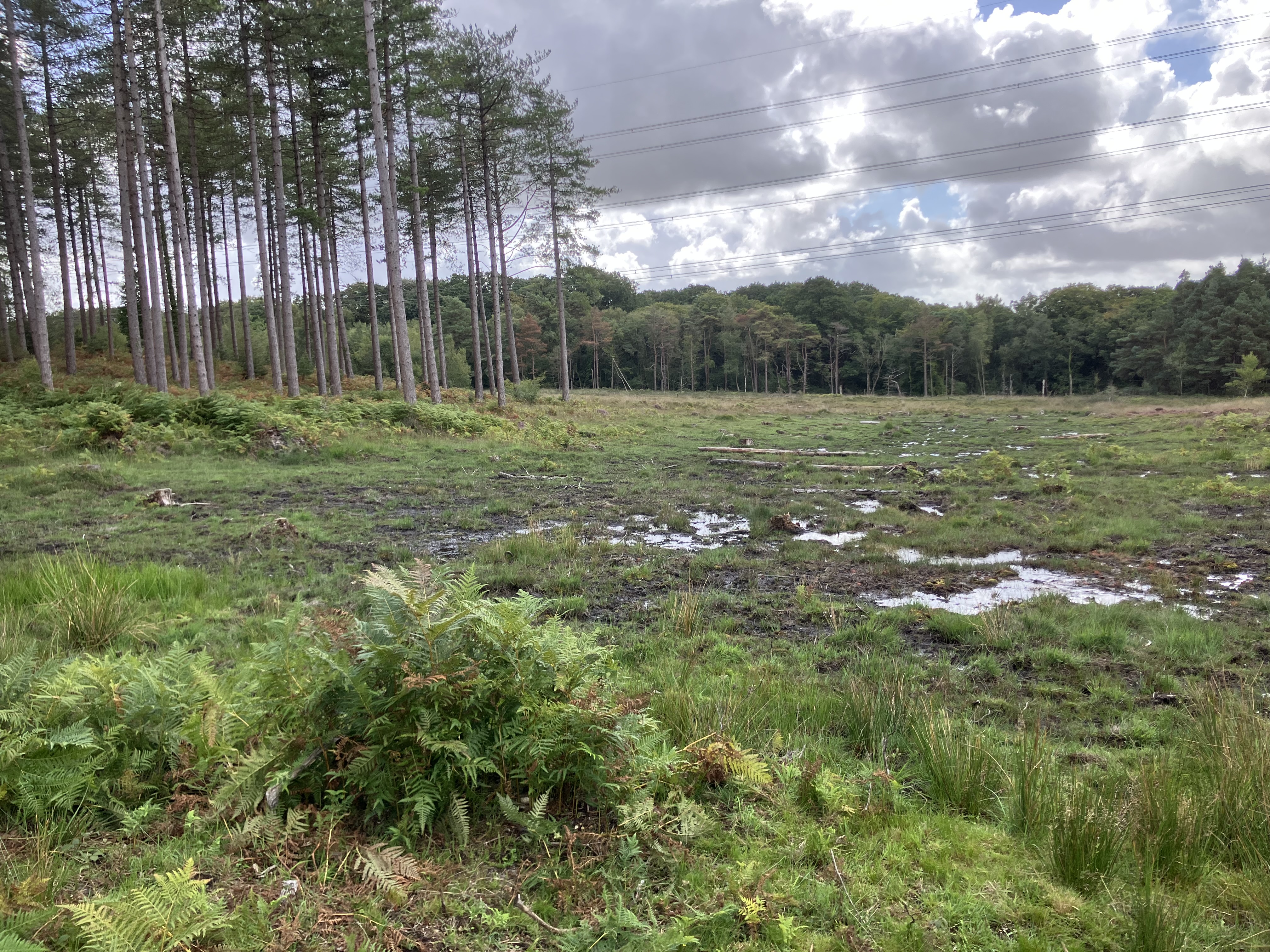
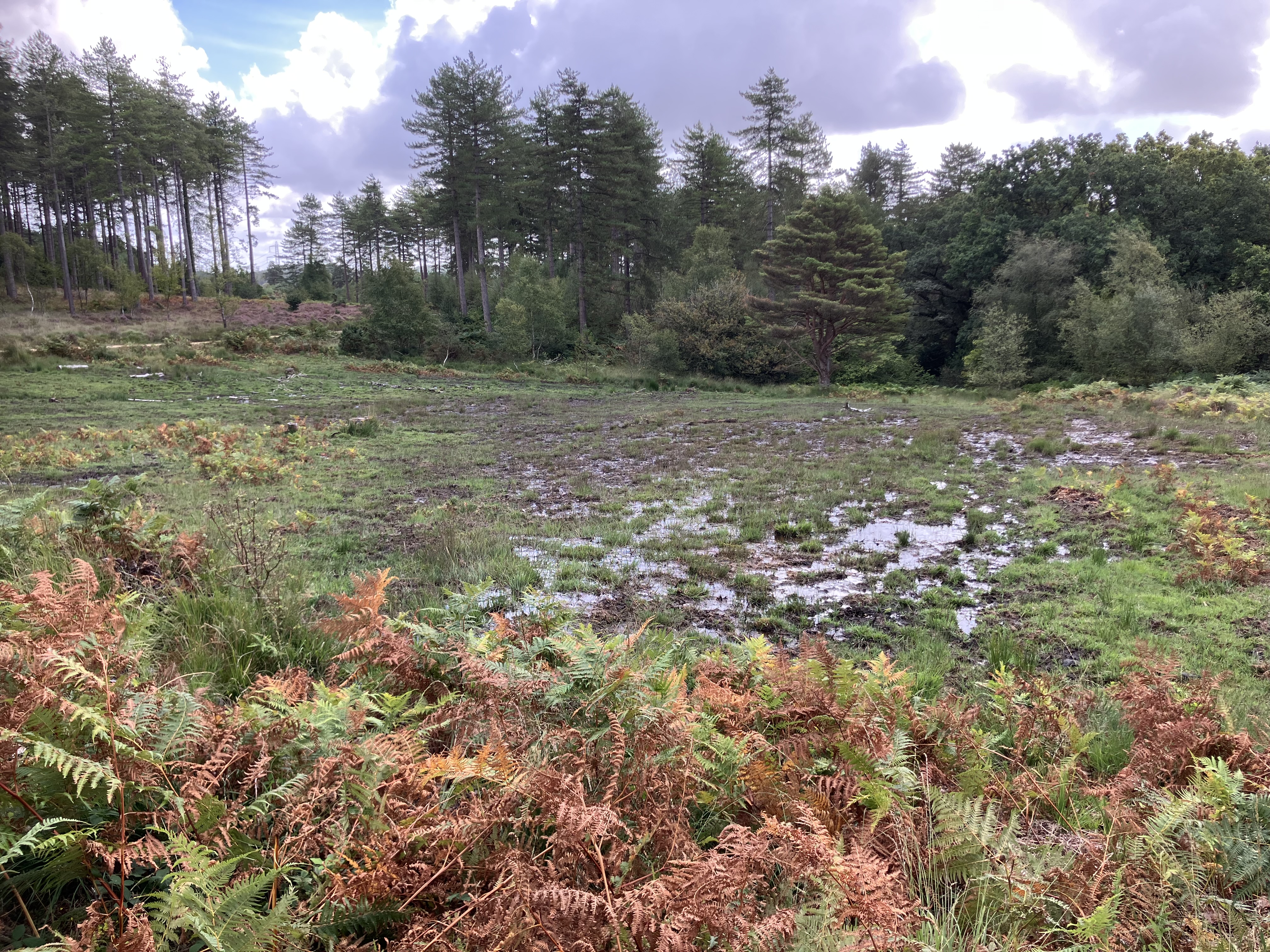
This work not only provides huge benefits in carbon sequestration (wet heath/peat being even better at locking up carbon than woodland), but it also reduces flooding further down the water course and provides beneficial habitat for a huge range of wildlife (amazing numbers of dragonfly & damselfly present through this summer!!). These areas have also benefitted from the continued cattle grazing under CSS, with the new accessible growth attracting the cattle and their subsequent grazing producing a diverse mosaic of wildlife beneficial habitat.
The main reason for reaching out is to let you know about the track edge improvements we have planned through Pallington Heath & Affpuddle/Briantspuddle, I’ve attached our plans below if anyone is interested in seeing the exact details:
Briantspuddle Heath
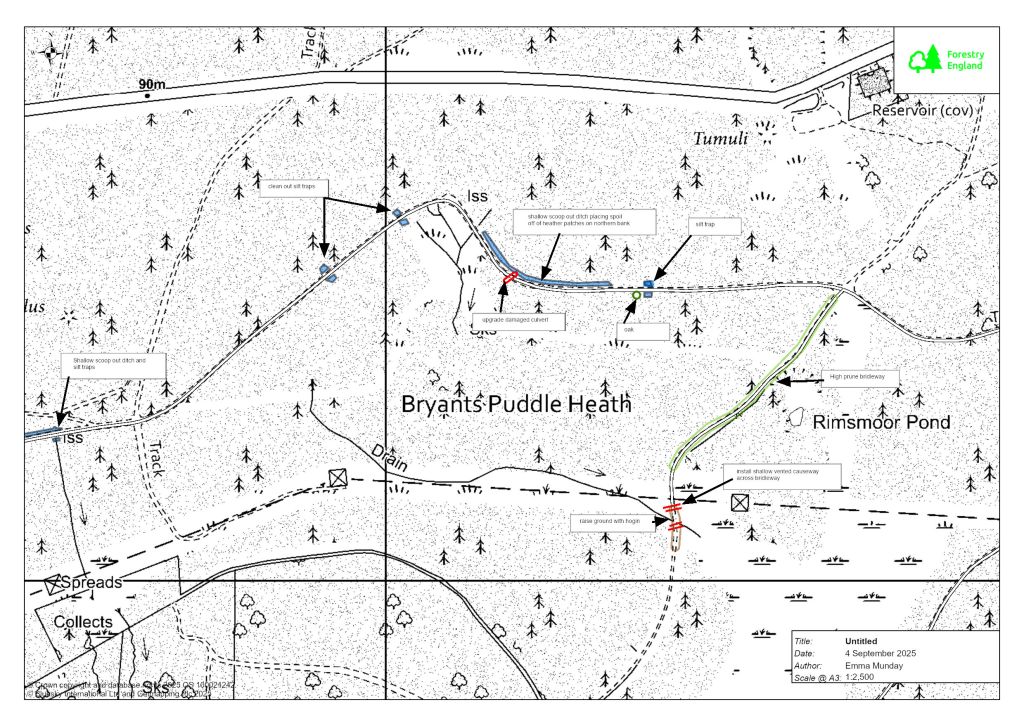
Pallington Heath

The ditches that were created when the forest/roads track were first installed have produced some excellent habitat for a range of wildlife, including most notably breeding habitat for Palmate Newts. Our challenge is to ensure the roads/tracks remain in an operational condition, whilst at the same time retaining as much of the wildlife suitable habitat as possible. The key elements of the planned operations we are undertaking are as follows;
- Clearing existing culverts, to ensure the water flow points under the tracks are maintained.
- Create additional habitat for wildlife (notably the resident newt populations), this builds on the existing track edge ditches both expanding those areas as well as providing some scrapes out with those ditches.
- Sensitively clear sections of the existing track edge drains to facilitate waterflow, whilst retaining the those sections that are currently offering the best habitat for existing amphibian populations.
- Building up selected sections of the track/road with site suitable substrate (as dug hoggin).
We also manage Wareham Forest, and I am acutely aware that the residents of Bere Regis will also have an interest in our management within that particular forest block. Please do let us know if you would also like to learn more about our plans within Wareham Forest.
If anyone is interested in viewing our overriding Forest Plans, please use the following publicly accessible link Purbeck Forest Plan | Forestry England You will need to select the individual forest block you are most interested, i.e Affpuddle & Moreton, Wareham & Gore Heath etc.
I am more than happy to expand on any of the elements noted above, or anything else you wish to understand about Forestry England’s management of your local forests.
Mark Warn BEM
Wildlife Ranger & Landscape Recovery Manager, Wareham Beat
Forestry England
m: +44 (0) 7881 502221 Teams: +44 (0) 1174 711871
The Erica Trust
About the Trust
The Erica Trust is a small charity started in 2010 to complement work done by the other voluntary wildlife groups in south-east Dorset. The Trust already owns 400 acres, mostly heathland and grassland, around Verwood, Ferndown, and Merley, and it was thrilled to be able to secure the 100 or so acres which formed Lot 3 in the sale of the Neill’s estate coloured in on the map below.

As its founder and one of three trustees, I can be found most weekends at Little Thatch on the Briantspuddle cross-roads. The charity’s plan is to restore and enhance the amenity and wildlife interest of the land, putting it back to the form in which some of our long standing residents can still remember it – a combination of old broad leaved woodland along the lower ground leading up to sunny heathland above.
To achieve this the northern third of the site will have the majority of the tall ‘alien’ conifers taken out, so the old oak and the beech woodland through which the public footpath runs, can be seen again in its full glory. The hazel understorey will be encouraged by coppicing, and holly controlled. With the shading conifers reduced and light getting through, the broadleaves should start to regenerate themselves again and the bluebells, primroses, wood anemomes and wood sorrel that we all enjoy so much will thrive.
The southern two thirds of the site will have the majority of the Scots pines taken off, so that the former heathland will come again into its own. Any characterful pines, birches and hollies will be left to break up the landscape. Culpeppers Dish will be come obvious again. Work will not start until 2019, and trees will be mostly, if not entirely, taken out southwards over temporary brash based tracks. The plan is also to provide better access by permissive paths linking the existing footpaths and bridleways so we can properly enjoy seeing our local and heathland wildlife flourish.
The ‘allotments plantation’ and surrounds remain in private ownership, however our different but complementary management programmes will ensure maximum variety of habitats and landscape types. If you have any information to pass on or comments you would like to make do please contact Lesley on email lesleyhaskins@hotmail.co.uk or call in at Little Thatch at Briantspuddle Crossroads at weekends.
Update Spring 2025
All the projects listed in our 2022 update have been completed! Most apparent has been the restoration of heathland in the most eastern part of our land holding – we are calling it Starmoor Heath after the field name just north of it. The amount of brash under the old Monterey Pines in particular was huge and took two stabs at clearing. The tricky exotic tree removal above The Hollow Track proved as tricky as expected, but well worth the trouble, and native trees and shrubs, some planted to supplement those which will return naturally, will now fill the gaps.
The fenced deer exclosures in the earlier conifer clearings along this old bluebell wood have, as expected, filled with brambles. Expected because the extra light from conifer removal allows native trees to grow but also encourages brambles, and the protection for the young trees also protects those brambles! But it has been gratifying to see the number of young oaks and hazels coming on under the bramble cover. Once this native tree and shrub canopy forms, the brambles will naturally diminish. It is also gratifying to see how high up the slopes the bluebells and other old woodland flora is reappearing.
Down in our valley meadow either side of the footpath behind the village shop much of the divisive fencing has been removed and some floral diversity works undertaken. In the longer term it is hoped to restore the later summer grazing formerly practiced by the Estate.
Further Update Autumn 2022
Three of the four tree work sites that we hoped to tackle this season have been done namely
– the clear fell east of the footpath at Hollow Woods to restore heathland. The broadleaved woodland fringe will be encouraged to thicken up.
-the removal of the remaining hemlocks and pollarding of the limes at the bottom of Smokeham Bottom. Very much looking forward to seeing the limes respond to their new environment.
-the removal of Douglas fir alongside the Affpuddle Road. Native broadleaved woodland will be encouraged in its place.
Work on another hazel coup close to the Affpuddle Road will be taking place during this winter. However the proposed thinning of the exotic conifers between Allotments Plantation and Chapel Cottage will be held for another year.
Lesley Haskins.
Update Autumn 2022
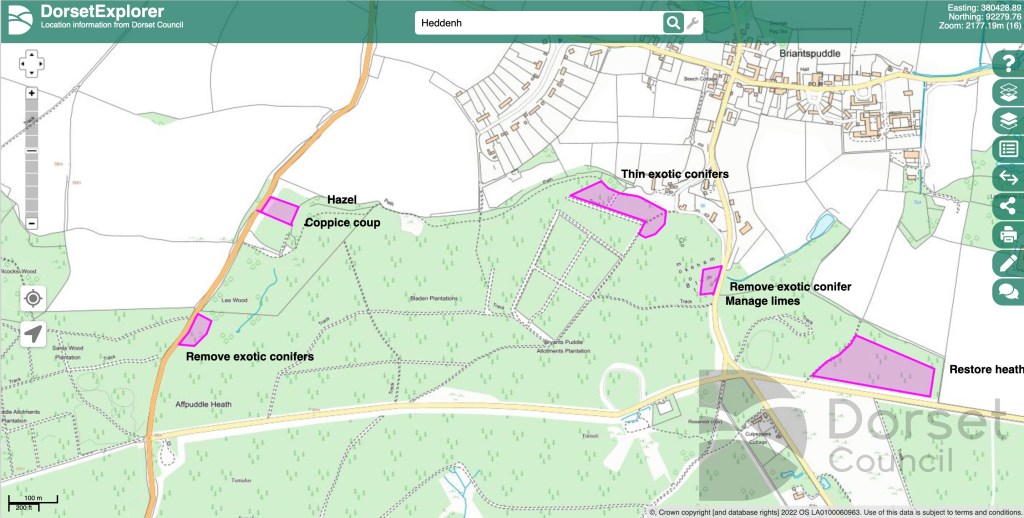
It has been wonderfully gratifying to have had so many reports of the wildlife expanding over or colonising the restored habitats of our landholding and to hear of those enjoying the recovering landscape. With the major works completed on our main land holding west of The Hollow Road, we are now following up with small scale improvements on some of the more tricky bits and pieces.
Foremost amongst these will be the wet ground at the base of Smokeham Bottom (just up from the entrance to Blackdown House) where we will be taking out the remaining few tall conifers which have proved troublesome. The lovely line of limes planted along the roadside, but grown so leggy because of the conifer shading, will be crown reduced, pollarded or coppiced according to their individual shapes – limes respond well to all these treatments. Oaks planted last winter further up the road have managed to survive this exceptional summer.
There will be some thinning out of the exotic conifers north of Allotments Plantation ie mostly those which can been seen protruding above the skyline when looking up from the bus shelter.
Right over the in the west, alongside the Affpuddle Road, the discreet enclave of exotic conifers will be removed. All extraction will be either southwards through the site and/ or along the roads to our usual the timber stack area.
Also alongside the Affpuddle Road a second tranch of coppicing will take place and the deer fencing moved from the now well grown first tranch to protect the new tranch.
General ongoing management will include more gorse coppicing along the ‘top road’.
On our land holding east of The Hollow Road (known as Hollow Woods) we have previously thinned out exotic conifers west of the bisecting footpath to encourage mixed woodland. East of the footpath we now intend to take out all the exotic conifers to restore heathland which will connect over the road to that owned and managed by Henry Hogger. The marginal broadleaved woodland will of course be retained and encouraged. Like our main land, this area also has a Wildfire Mitigation Plan including the fire retardant broadleaved woodland and access provision.
We hope to start in mid September and as always tolerance of our operations is much appreciated.
Lesley Haskins.
A Long View of Culpepper’s Dish
Not many people can claim to have had such a long term view of the remarkable landscape between Culpepper’s Dish and Briantspuddle Village than Mrs. Eileen Riglar. In the early 1960s Eileen was a member of a mainly female team employed by Sir Piers Debenham to plant conifers on the undulating plateau behind the Dish (the best known of Dorset’s swallet-holes) and down the slopes towards the village. On the plateau these conifers were planted on what Eilieen recalls as open purple heathland, and on the slopes they were planted under oak and bluebell woodland.
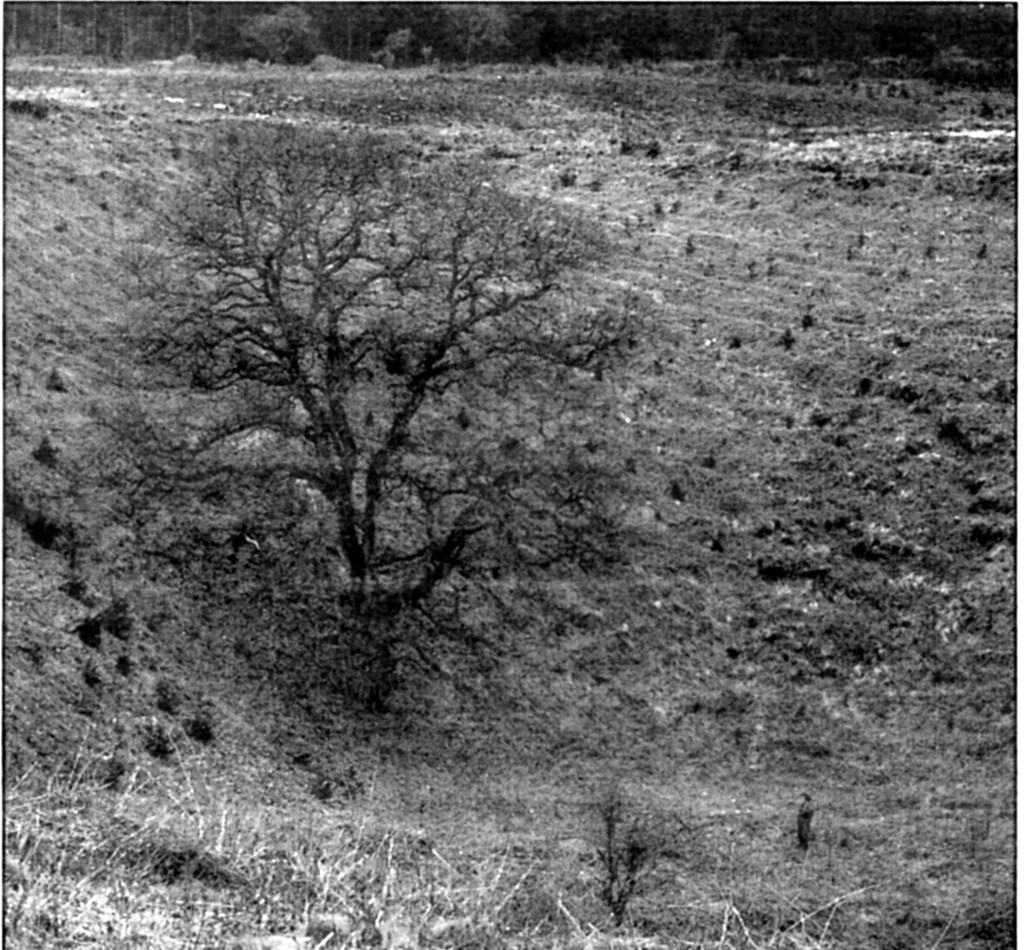
The photograph shows Culpepper’s Dish as it was just after planting took place – in a wide open landscape with just one majestic oak in its base. (Photograph by Geoffrey Poole 1968).
Thereafter Eileen was then able to view the impact of the conifers on the landscape over the years merely by looking from the back garden of her own home in Briantspuddle – where she has lived for over 60 years. The woodland of course became much darker as the conifers grew through and overtopped the oaks. The heathland on the plateau retreated to isolated pockets and rides.
In the last two years the conifers have fulfilled the purpose for which they were planted, and have been extensively removed and sent to the timber market. But times have changed with regard to the importance of the original landscape. The huge value to wildlife of the former heathland and old woodland is now widely appreciated. Following purchase of the land by The Erica Trust and the conifer cropping, tree regeneration will be largely discouraged on the newly-released heathland, while native broadleaved trees only will be encouraged in the newly-released old woodland. The heath will not be as starkly open as it was in the 1960s photograph, but open and sunny enough for sand lizards to return – to join the nightjars who have been very quick to take up summer residence. The woodland will again have enough light for the bluebells to flourish.
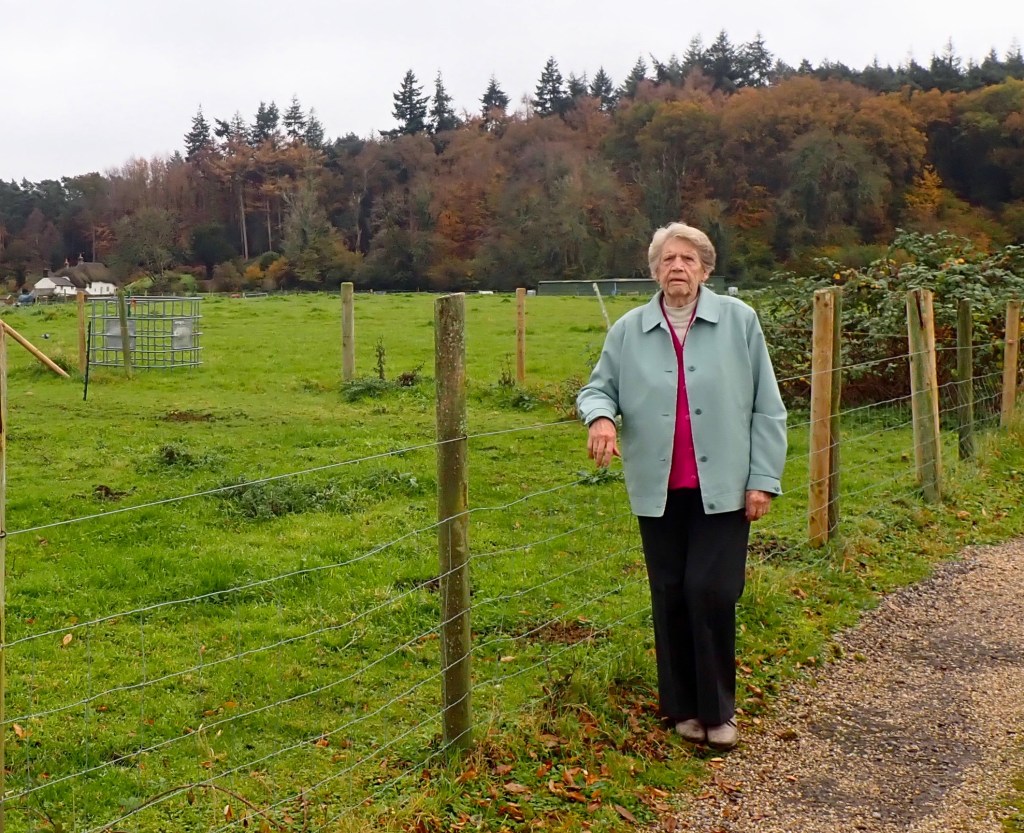
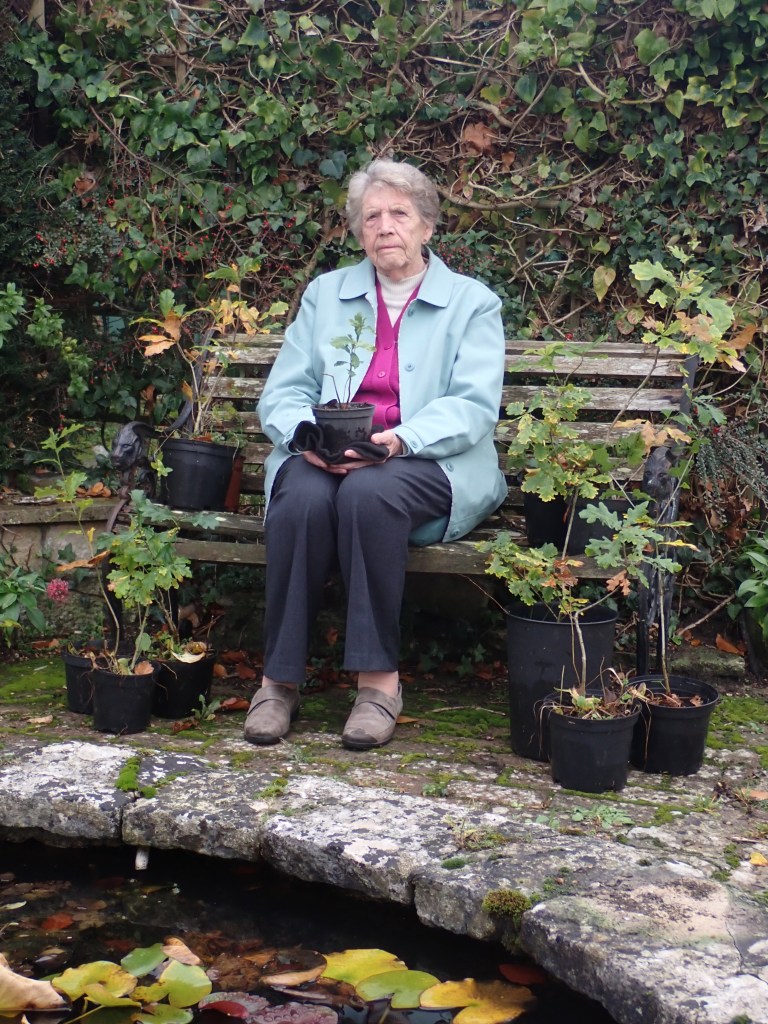
The photographs show Eileen Riglar in front of the wood where she planted conifers during her early years in Briantspuddle, and in her garden with some of the locally grown oak saplings to be planted in the gaps in the woodland now that many of those conifers have been removed.
Notes.
The Erica Trust is a small conservation charity formed in 2010 to undertake proactive wildlife projects in east Dorset. The charity currently owns approx 600 acres spread between Verwood, Ferndown, Wimborne and Briantspuddle. The managing Trustee is Dr. Lesley Haskins.
Swallet holes, or dolines, are circular depressions formed when the underlying chalk is dissolved by the overlying acid sands and gravels which eventually collapse to form an inverted cone.
Lesley Haskins November 2020
June 2020
Lesley Haskins writes: When we started our heathland and woodland restoration project at Briantspuddle we got off to a flying start. Indeed much of the heathland restoration was achieved in just January and February 2019 before stopping for the bird nesting season.
It was very frustrating then that no sooner had we started operations again in September to progress the woodland restoration than it started to rain – and basically never stopped. Whilst some reduction of the alien conifers was achieved, by Christmas it was quite evident that the ground conditions were just too bad to continue and so we reluctantly shut up shop, leaving the job very obviously unfinished. The slope above The Hollow has understandably raised a few eyebrows!
The contractors will get back to the task in the later summer, sorting the effects of the several back to back storms, extracting timber perforce left on the ground, and then continuing the remaining reduction of the standing exotic conifers. And of course dealing with the old and new brash – not by any further burning as we had to do on the heath, but by placement along the contour lines to provide habitat for wildlife with also open ground for tree seedlings to establish.
But even at this unfinished stage of project, the rewards are becoming evident. Right on cue, nightjars and woodlark have already come to breed on the newly restored heathland. More essential light already shines down the slopes through the woods to the old oaks, hazels and bluebells below – where dormouse has been recorded waiting to benefit from the coppicing cycle which has just been restarted after many years absence.

Photograph Lesley Haskins.
And in the autumn of 2021, with the main changes surely achieved, we can really look forward to more heathland plants and animals moving in, and to positively nurturing the remaining and new native trees which will return the old broadleaved woodland to its former natural glory.
Water Meadows
In course of investigation
 AFFPUDDLE & BRIANTSPUDDLE